

VX - Viewer Experience
VX: Why Viewer Experience is Critical to Modern Video Marketing
We have witnessed over the last 15+ years of running a video production company, Video become the most powerful marketing tool on the planet, but the way most businesses and brands approach it is still surprisingly outdated. Far too often an afterthought, or a tick box exercise with a focus on number of deliverables.
What almost nobody talks about, is the experience the viewer has when watching that content.
Not the brand message.
Not the production value.
Not the trend of the month.
The viewer’s experience.
That’s what drives the outcome, and that’s what the industry keeps overlooking.
This is why we have started using a framework internally we call VX – Viewer Experience. A practical way to break down what makes video work for audiences, not just what makes it good from a creative or technical perspective. And we genuinely believe that in the next few years, Viewer Experience will become one of the major deciding factors in whether marketing videos actually succeed.
Before jumping into production or creative ideas, we often pair VX with a simple planning tool we use called ‘Mind the GAPP’; looking at Goals, Audience, Platform and Promotion. GAPP ensures the strategy is right before you start, and VX ensures the viewer’s experience is right once the content is created.
Let us explain what we mean, and why VX matters more now than it ever has.
What We Get Wrong About Video Marketing
Most underperforming videos fail for one simple reason (if we don’t include lack of promotion!):
They’re built around what the brand wants to say, not how the viewer is going to experience it.
Brands talk too much; we all do.
They assume attention is automatic.
They overthink visuals and underthink clarity.
And they forget that the viewer is always one swipe away from something more interesting.
We spend so much time choosing the “right” music, the “right” transitions, the “right” colour grade, but none of that means anything if the viewer:
- Isn’t hooked
- Doesn’t feel anything
- Can’t follow the message
- Finds it difficult to watch
- Doesn’t know what to do next
This is the gap VX fills.
Introducing VX: Viewer Experience
Viewer Experience (VX) is a simple, audience centred way of planning and evaluating video content. Instead of focusing on what we want to say, VX forces us to consider how they, the viewer, will engage and react to the content.
It breaks down into a structured model that we have internally called the VX5 Checklist, which captures the five psychological stages every viewer goes through when watching a marketing video:
- Attention Acquisition
- Engage & Resonate
- Cognitive Clarity
- Consumption Ease
- Action / Conversion
These stages happen quickly, sometimes subconsciously, but they directly influence whether a video succeeds or fails.
The framework gives marketers, creatives, and business leaders a way to talk about video effectiveness that’s measurable, strategic, and easy to apply.
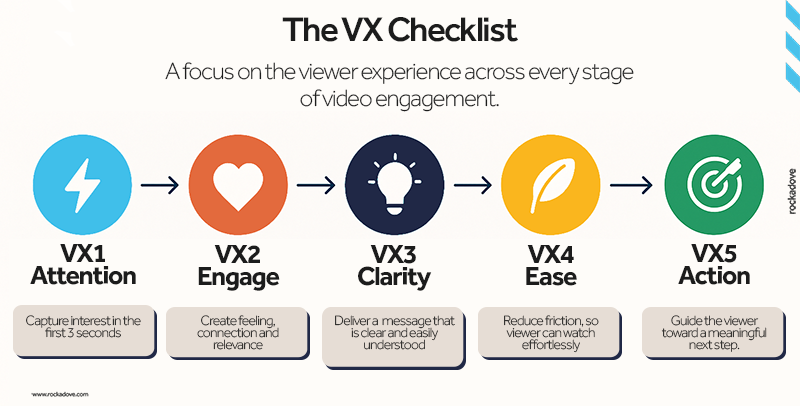
So let’s break each stage down.
VX1: Attention Acquisition – winning the first 3 seconds
The biggest problem in marketing today is the assumption that people want to watch your content. They don’t. They want to scroll past it.
Grabbing attention is the most important part of video marketing.
If you can’t earn it, nothing else matters.
Attention Acquisition is about designing the opening of your video with intent, not leaving it to chance. This means asking questions like:
- What will make someone stop scrolling?
- What visual or narrative trigger appears instantly?
- Does the first frame look different from everything else in their feed?
- Does it spark curiosity, tension, or relevance?
Strong VX1 could be: A bold visual, someone reacting to something, a pondering question, an answer that intrigues us (“Here’s the mistake we all make…”)
The job of VX1 is simple: make the viewer decide to stay. So please don’t insist your logo is on screen for the first 5 seconds!!
If they don’t decide to stay, the video ends before it begins.
VX2: Emotional Resonance – making the viewer care
Attention gets someone to stay for a moment. Emotion gets them to stay for the duration.
Emotion doesn’t always mean “tear-jerking” or dramatic. It simply means creating a feeling: trust, humour, relevance, recognition, relief, empathy, excitement.
This stage is where storytelling becomes powerful. People respond to relatability, familiarity, tone and pace.
If the viewer doesn’t feel anything…they won’t remember anything!
And if they don’t remember, they won’t act.
There is plenty of beautiful videos out there, but when it ends you still have no idea who it was for, what it was about or possible next steps.
VX2 is the heart of your impact.
VX3: Cognitive Clarity – helping the viewer understand effortlessly
This is where most videos unintentionally fall apart.
Even highly polished videos; beautifully shot, well edited, can lose people because they’re confusing. Often by trying to cram too much info into the script, being too jargon heavy, or trying to do too much with visuals.
Cognitive load is real. If the viewer has to work to understand your message, you’ve already lost them. Dumb down your scripts and visuals, and be precise with what you want to talk about.
VX3 focuses on:
- Clear narrative structure
- Purposeful editing
- Information hierarchy
- Clean visuals
- Direct, simple language
When the message is instantly understandable, your audience will stay to watch.
VX4: Consumption Ease – reducing viewing friction
Even if the content is interesting and clear, the viewer experience can still suffer if the video isn’t easy to consume.
This is the stage that deals with the practical viewing experience, from duration, pace, accessibility and optimisation.
Great videos don’t just communicate well, they flow effortlessly, on the chosen platform they were made for.
Consumption ease is one of the hidden drivers of video view retention. Most brands overlook it completely.
VX5: Action Conversion – guiding behaviour without forcing it
The final stage is where video translates into results.
This is also where Mind the GAPP becomes relevant again. If the goal, audience, and platform weren’t clearly defined at the start, your action stage will always struggle. ‘Mind the GAPP’ sets the destination, and VX5 makes sure the viewer actually takes the step you intended.
This is not about sticking a CTA on screen at the end. It’s about designing the emotional and psychological pathway that makes the viewer feel ready to act. Good VX5 strategy means the viewer feels clarity, connection and the next step feels obvious and easy.
The action could be a click, a signup, a donation, a share, or simply a change in perception, whatever the goal, VX5 ensures the video supports it.
Why VX Matters More in 2026 Than It Did Even Two Years Ago
Three major industry shifts make Viewer Experience critical right now.
- Attention scarcity is worse than ever
Your audience is inundated with video content and they just don’t care what you have to say. The businesses and brands that win are those who design for attention, not assume it.
- AI video adding to the noise
With so many options of AI software that can generate video for you in seconds, we will all be inundated with more and more “content” in 2026. Deciphering what is real or AI generated will become harder, so creating great human-centric video, with the viewers experience in mind should cut through the noise.
Do it correctly now, to build brand authority and authenticity, to be well positioned in the years to come.
- Marketing is finally being held accountable for outcomes
The days of “pretty films” with no measurable impact are dead.
Businesses want measurable results and video is no exception. VX aligns creativity with commercial outcomes, and providing video is promoted, it could be the missing link between storytelling and ROI.
The Most Common Signs a Video Has Poor VX
If a video underperforms, it usually breaks down in one of these ways:
- Strong visuals, weak hook (poor VX1)
- Good story, no emotional pull (poor VX2)
- Too complex or too fast (poor VX3)
- Hard to watch on the platform (poor VX4)
- No clear reason to act (poor VX5)
The VX framework makes these issues diagnosable and fixable.
How to Apply VX to Real Marketing Projects
Here’s the process we use:
Before developing the creative
- Consider ‘Mind the GAP-P’
- Identify the viewer’s intent and mindset
- Design a deliberate hook (VX1)
- Plan emotional beats (VX2)
- Simplify the message (VX3)
During creative and production
- Prioritise clarity in visuals and pacing
- Capture real moments
- Keep shots purposeful, not decorative
In post-production
- Edit for flow and ease, with the platform in mind (VX4)
- Strengthen structure
- Reinforce the CTA pathway (VX5)
Once it’s live
Review video analytics through the VX lens:
- Where do people drop off?
- What moment triggers rewatches?
- Does the title thumbnail align with VX1?
- Does completion rate align with VX4?
This approach creates better content AND better decision making. Don’t be afraid of A/B testing elements of the video and indeed re-editing to improve the engagement metrics. Video is like any other marketing, invest the time and effort to get it right, and always consider refinements if needed.
What Happens When Businesses Start Using VX
You see measurable improvements, fast:
- Higher retention
- Higher completion rates
- Better comprehension
- Greater emotional impact
- Stronger brand associations
- More meaningful actions
- Better ROI
- Increase in brand recognition
That being said, this requires including video in early discussions, investing in video centric creative, production and promoting that content. This is a shift from ticking the video box for a campaign, to engaging true video experts in planning discussions, to do it right first time. Following the VX checklist doesn’t mean big budget increases, it is just an opportunity to more careful consider the viewer as part of creative planning and execution.
The Future of Video Belongs to Brands Who Optimise for Viewer Experience
We’re moving into a world where:
- AI can generate video
- Viewers have zero patience
- Platforms reward high engagement
- Authenticity matters
In this environment, the brands who thrive will be the ones who put the viewer first.
Viewer Experience is not a trend.
It’s the foundation of effective video marketing going forward.
If you design for the viewer, you win.
If you ignore the viewer, the platforms will ignore you, and so will your audience.